Elephant Seals and a 150-Year-Old Lighthouse Share One Remarkable Stretch of California Coast: Here’s what to know
About six miles north of Hearst Castle along Highway 1, the Piedras Blancas Light Station rises from a windswept coastal point where an 1875 brick lighthouse and one of the world’s largest northern elephant seal rookeries occupy the same few miles of central California shoreline. The Bureau of Land Management oversees the area as both a historic park and a wildlife sanctuary, with the name derived from the pale offshore rocks visible from the bluff — piedras blancas meaning “white rocks” in Spanish. Workers completed and first lit the tower on February 15, 1875, and for decades its beam guided ships away from the rocky coastline using a first-order Fresnel lens manufactured in France in 1872. A 1948 earthquake forced crews to remove the tower’s top three levels the following year, though the original lens survived and is now on display in the nearby town of Cambria. A modern lens was installed after the rebuild, and the lighthouse continues operating today, sending a flash every ten seconds to vessels passing in the dark.
Access to the light station is by guided walking tour only, with docents leading visitors through the tower’s base and the restored support buildings that once kept the remote outpost running. Tours cover an easy half-mile interpretive trail and typically last around two hours. Tickets are $10 for adults and $5 for visitors aged six through seventeen, with reservations made through Recreation.gov. Tours run Tuesday, Thursday, and Saturday most of the year, expanding to additional days between June 15 and August 31, with groups meeting at the former Piedras Blancas Motel on Highway 1, roughly 1.5 miles north of the station. Separate from the lighthouse, the elephant seal rookery stretches across approximately eight miles of coastline just south of the light station and is free to visit daily from sunrise to sunset, with no reservation required. At peak population, more than 25,000 northern elephant seals pack the sand, ranking the rookery among the largest of its kind on Earth. Adult male elephant seals can reach up to 16 feet in length and weigh as much as 5,000 pounds, and the distinctive trunk-like nose that gives the species its name amplifies a deep, resonant call audible before the animal comes into view. Elevated viewing platforms positioned just above the beach allow visitors to observe the seals at close range without disturbing them, and volunteer docents in blue jackets are on hand to answer questions. The Boucher Trail connects the rookery parking area to the lighthouse along nearly two miles of flat coastal bluff, crossing grassland, wetland edges, and rocky headland.
“The seals come and go across the calendar, but three windows pull the biggest crowds onto the sand. Late January draws the most activity, when most pups have already been born and the beach becomes a nursery. Come May, the seals return in large numbers to molt, shedding their old coats and growing new ones over several weeks. Late October brings the young seals hauling out to rest after their time at sea.”
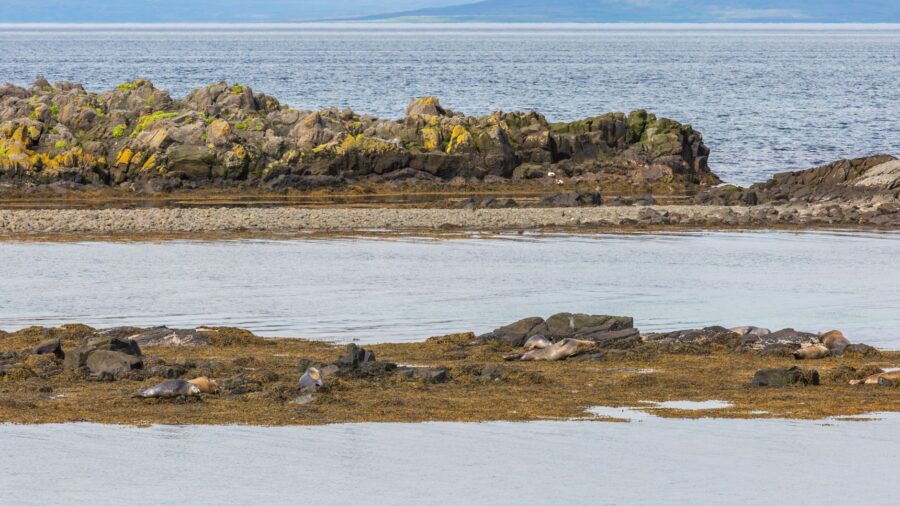
The waters surrounding Piedras Blancas support a wide range of additional wildlife, with sea otters resting in the offshore kelp beds and gray, humpback, and blue whales passing through on seasonal migrations. Harbor seals, sea lions, and dolphins frequent the coves, while the tidepools north of the light station shelter sea stars, anemones, and crabs within a protected marine reserve. The pale offshore rocks that give the point its name attract dense concentrations of cormorants, brown pelicans, and gulls, with peregrine falcons occasionally sheltering among the outcroppings and hawks and turkey vultures riding thermals above the bluffs. The light station itself holds multiple layers of protected status, sitting within the California Coastal National Monument, designated as a federal Outstanding Natural Area, and listed on the National Register of Historic Places. Volunteers have contributed more than 100,000 hours to restoring the site. Visitors are advised to dress for wind and bring binoculars.
Leave a Reply