Idaho’s Henry’s Fork drops through five waterfalls and almost nobody stops to look: According to reports
Shutterstock
It’s Yellowstone’s quiet next-door neighbor
Most people drive right past eastern Idaho on their way to Yellowstone. That’s a mistake. The Henry’s Fork of the Snake River cuts through old volcanic rock here, and the water drops off ledges the whole way down. You get waterfalls, trout pools, a cabin built by hand, and a wildlife refuge where trumpeter swans float past moose standing in the shallows. The whole corridor runs through Caribou-Targhee National Forest, and you’ll share it with almost nobody. Shutterstock
Sheep Falls spreads wide across dark lava rock
Sheep Falls doesn’t drop far, but it stretches across the Henry’s Fork like a curtain. The river pushes over a broad rock ledge, then funnels into a narrow chute carved from dark lava. You can walk close to the edge and look straight down into the moving water. The sound fills the small canyon around you. Smooth rock ledges frame the pools below, and the whole scene sits deep enough in the forest that it feels like your own. Most days, it is. Shutterstock
A million-year-old volcano built these falls
The rock under your feet here came from the Yellowstone hotspot. More than a million years ago, a massive eruption created the Island Park Caldera, a collapsed volcano that left thick layers of basalt across the region. The Henry’s Fork carved its channel down through that volcanic rock over centuries. You can see the evidence everywhere around Sheep Falls. The dark, jagged shapes along the riverbank are solidified lava, worn smooth in some places and rough in others by the constant push of water. Shutterstock
A pine-shaded trail drops you to the river
The hike to Sheep Falls starts from a small parking area and drops downhill through shady pine forest. It’s short, and the path is easy on the way in. Wildflowers line the trail in summer. The lava rock near the water has a worn, pitted texture from years of river spray. Take your time down there, because the return trip climbs back uphill and will remind you that gravity works both ways. It’s the harder half of an otherwise simple walk. Shutterstock
Fly anglers come here for the trout
The Henry’s Fork is one of the most famous trout rivers in the country, and Sheep Falls sits right in the middle of it. Anglers know this stretch well.
The water runs cold and clear, and the rocky pools below the falls hold healthy fish. Even if you don’t carry a rod, you can watch the current move over the stones and spot trout holding in the deeper runs. The river here connects to a larger network of fishing water that draws people from across the West. Shutterstock
Upper Mesa Falls plunges 114 feet off a cliff
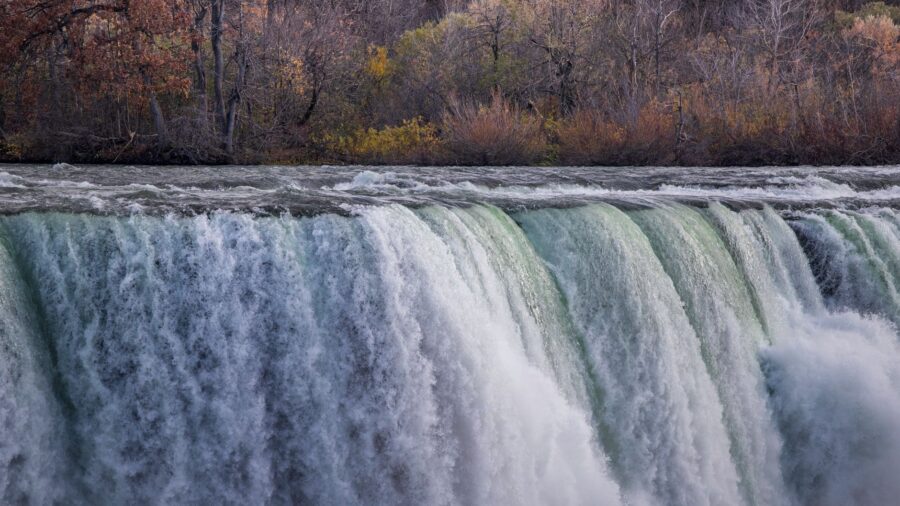
A short drive south from Sheep Falls brings you to the corridor’s biggest drop. Upper Mesa Falls sends the Henry’s Fork over a 114-foot cliff of hardened volcanic rock, and you feel the spray before you reach the viewing platform. Boardwalks and overlooks bring you right to the edge, and some of the pathways work for wheelchairs and strollers. This is one of the last large waterfalls in the region that no one ever dammed or diverted. The river falls here the same way it always has. Shutterstock
A century-old log lodge sits above the roar
Right above Upper Mesa Falls, a rustic log lodge looks out over the river. Builders put it up in the early 1900s to serve travelers passing through this stretch of Idaho. Today it works as an interpretive center where you can stop, rest, and read displays about the geology and history of the Henry’s Fork corridor. The building sits on the National Register of Historic Places. You can stand on the porch and hear the falls hammering the rocks below. Shutterstock
Lower Mesa Falls squeezes between basalt columns
A few minutes downstream, the Henry’s Fork drops again. Lower Mesa Falls falls about 65 feet, and here the river squeezes between tall columns of dark basalt. The best view comes from an overlook at a nearby campground, a site the Civilian Conservation Corps built in the 1930s. Between Upper and Lower Mesa Falls, you get two big drops on the same river in a short stretch of road. The pair hits harder together than either one would alone. Shutterstock
Big Springs pumps 120 million gallons a day
North of Island Park, the Henry’s Fork starts at Big Springs. More than 120 million gallons of water push up from the ground here every day, and the temperature holds at about 52 degrees year-round, warm enough that it never freezes. You can stand on a footbridge and look down into crystal-clear pools where huge trout drift in the current. Nobody fishes here. It’s not allowed, so the trout grow big and calm. They’ll swim right under your feet without flinching.
Read more from this brand:
One exit near Twin Falls drops you into a canyon with waterfalls, BASE jumpers, and kayakers
Two of America’s richest families kept this Idaho ranch secret for 75 years; now anyone can walk it
Most Americans drive past southern Idaho and miss a waterfall bigger than Niagara
The post Idaho’s Henry’s Fork drops through five waterfalls and almost nobody stops to look appeared first on When In Your State.
Shutterstock
Johnny Sack built his cabin by hand near the spring
Near Big Springs stands a handmade log cabin that a German immigrant carpenter named Johnny Sack built in the early 1930s. He cut local wood and crafted the cabin and all its furniture himself. A small water wheel nearby once pulled electricity from the spring. The cabin is on the National Register of Historic Places and opens for tours in summer. You can walk through the rooms and see the kind of work a person can do with raw timber and enough patience. Shutterstock
Trumpeter swans and moose share this refuge
Harriman State Park spreads across a large wildlife refuge where the Henry’s Fork winds for about eight miles through meadows and past lakes. This is one of the best places in the region to spot trumpeter swans. Moose browse along the riverbanks, elk graze in the open fields, and sandhill cranes stalk the shallows. Miles of easy, flat trails follow the water, so you can cover ground without climbing. Bring binoculars. You’ll use them. Wikimedia Commons/Gillfoto
Railroad families turned their ranch into a park
Harriman started as a working cattle ranch called the Railroad Ranch, owned by the Harriman and Guggenheim families of railroad fame. Many of the original ranch buildings still stand, and you can walk through them on guided tours in summer. The stories of ranch life here go back generations. The whole Henry’s Fork corridor, from Sheep Falls to Harriman, gives you waterfalls, wildlife, and history without the crowds that pack Yellowstone just over the state line to the east. Shutterstock
Hit the trail at Sheep Falls in eastern Idaho
You can reach Sheep Falls by taking Sheep Falls Road off US-20 between Ashton and Island Park. The access road is rough gravel and dirt, so a high-clearance vehicle helps. The hike to the falls is short but returns uphill, and parking is limited. This is bear country in the Greater Yellowstone Ecosystem, so follow posted wildlife safety guidance. Check conditions with the Caribou-Targhee National Forest’s Ashton/Island Park Ranger District before you go, since road and trail access can change with the season. This article was created with AI assistance and human editing. Read more from this brand:
One exit near Twin Falls drops you into a canyon with waterfalls, BASE jumpers, and kayakers
Two of America’s richest families kept this Idaho ranch secret for 75 years; now anyone can walk it
Most Americans drive past southern Idaho and miss a waterfall bigger than Niagara
The post Idaho’s Henry’s Fork drops through five waterfalls and almost nobody stops to look appeared first on When In Your State.
Leave a Reply